August, 2010

It's about sportsmanship
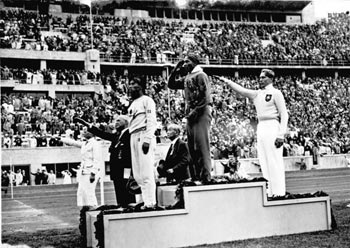
Jesse Owens after winning the gold medal at the 1936 Summer olympics. Luz Long is on the extreme right. (Hoffman, Wikimedia)
For most athletes, there is no greater honour than winning an Olympic Gold Medal. But, great athletes show us that winning isn't everything...
Jesse Owens of the United States was one of the best athletes at the 1936 Olympics. However, he had trouble qualifying for the long jump finals. Owens tried and tried, until he had only one chance left.
At that point, some of his rivals may have been secretly happy. If he didn't make it to the finals, they would have less competition.
But, Luz Long of Germany didn't think that way. Long stood a good chance of winning. If Owens was knocked out, Long would be much closer to every sportsman's dream: an Olympic gold medal.
Despite this, he walked over to the American and suggested another way of jumping. Owens listened to Long's advice - and it worked. Owens made it to the finals, and won the gold.
Guess who was the first person to congratulate Owens? Yes, Luz Long. At that moment, Long won something more valuable than the gold - he won the respect of his fellow sporting heroes. Luz Long showed us what it means to be a true sportsperson. Winning isn't everything. Sports experts say that sportsmanship is also about integrity, fair play and respect. And their research shows us that the majority of players and athletes still practise these values.
INTEGRITY
The integrity in sportsmanship is your conscience - your inner voice telling you what is right and wrong - while you're playing.
At the 1932 Olympics, the officials announced that Judy Guinness of Britain was the winner for fencing. Only Guinness noticed that the officials had missed out two points against her. Instead of staying quiet and walking away with the gold, she pointed out the mistake to the officials. Those two points deducted cost her the gold. She took home the silver medal instead.
That's integrity for you.
FAIR PLAY
How you play the game is as important as winning. Like some of you, Roger Rees was a rugby player when in school. In those days in Britain, there was only one referee and 15 players per team. Because the referee wasn't able to see everything, players could get away with foul play quite easily. Yet, Rees can remember only one time when a player broke the rules by punching an opponent.
The players seemed to have an unwritten code of fair play, so it didn't matter that the referee couldn't see everything.
Today, Roger Rees is a university professor who does research on fair play and sportsmanship (or, as he reminds us, "sportspersonship", since it's not just for men).
His research shows that fair play and victory go hand in hand: "Playing fair is important because cheating cheapens the victory and makes it worthless and unearned."
RESPECT
Good sportsmanship is also about respecting your opponent, your coach, your teammates and yourself. Now, that may be hard to practice during an exciting interschool match. That's why some schools have sports codes for both players and fans. Sports codes remind everyone about the importance of sportsmanship. You'll find one example of such codes at the bottom of this article.
So, have a healthy attitude about winning and losing. You should, of course, try to win – but if you don't, be a good sport about it.
Play because you really enjoy playing. Play because it feels great when you're giving your personal best.
And, remember, this philosophy doesn't just apply to sports. You can use it for everything else you do in life as well!
In the heat of competition, it's tough to remember sportsmanship. That's why some schools use "sports codes" to remind players and fans that winning isn't everything.
HERE'S ONE EXAMPLE...
A Sports Code for Players
I WILL
I WILL
This article first appeared in the August 2004 issue of What's Up.
Re-published here in August 2010.
Jesse Owens of the United States was one of the best athletes at the 1936 Olympics. However, he had trouble qualifying for the long jump finals. Owens tried and tried, until he had only one chance left.
At that point, some of his rivals may have been secretly happy. If he didn't make it to the finals, they would have less competition.
But, Luz Long of Germany didn't think that way. Long stood a good chance of winning. If Owens was knocked out, Long would be much closer to every sportsman's dream: an Olympic gold medal.
Despite this, he walked over to the American and suggested another way of jumping. Owens listened to Long's advice - and it worked. Owens made it to the finals, and won the gold.
Guess who was the first person to congratulate Owens? Yes, Luz Long. At that moment, Long won something more valuable than the gold - he won the respect of his fellow sporting heroes. Luz Long showed us what it means to be a true sportsperson. Winning isn't everything. Sports experts say that sportsmanship is also about integrity, fair play and respect. And their research shows us that the majority of players and athletes still practise these values.
INTEGRITY
The integrity in sportsmanship is your conscience - your inner voice telling you what is right and wrong - while you're playing.
At the 1932 Olympics, the officials announced that Judy Guinness of Britain was the winner for fencing. Only Guinness noticed that the officials had missed out two points against her. Instead of staying quiet and walking away with the gold, she pointed out the mistake to the officials. Those two points deducted cost her the gold. She took home the silver medal instead.
That's integrity for you.
FAIR PLAY
How you play the game is as important as winning. Like some of you, Roger Rees was a rugby player when in school. In those days in Britain, there was only one referee and 15 players per team. Because the referee wasn't able to see everything, players could get away with foul play quite easily. Yet, Rees can remember only one time when a player broke the rules by punching an opponent.
The players seemed to have an unwritten code of fair play, so it didn't matter that the referee couldn't see everything.
Today, Roger Rees is a university professor who does research on fair play and sportsmanship (or, as he reminds us, "sportspersonship", since it's not just for men).
His research shows that fair play and victory go hand in hand: "Playing fair is important because cheating cheapens the victory and makes it worthless and unearned."
RESPECT
Good sportsmanship is also about respecting your opponent, your coach, your teammates and yourself. Now, that may be hard to practice during an exciting interschool match. That's why some schools have sports codes for both players and fans. Sports codes remind everyone about the importance of sportsmanship. You'll find one example of such codes at the bottom of this article.
So, have a healthy attitude about winning and losing. You should, of course, try to win – but if you don't, be a good sport about it.
Play because you really enjoy playing. Play because it feels great when you're giving your personal best.
And, remember, this philosophy doesn't just apply to sports. You can use it for everything else you do in life as well!
In the heat of competition, it's tough to remember sportsmanship. That's why some schools use "sports codes" to remind players and fans that winning isn't everything.
HERE'S ONE EXAMPLE...
A Sports Code for Players
I WILL
- Participate because I really want to.
- Play by the rules and in the spirit of the game.
- Acknowledge all good plays or performances by my team and the other team as well.
- Respect both teams, the coaches and referees and recognize that all of us are needed to make the game possible.
- Treat opponents the way I would like to be treated: I will wish them well before the game, congratulate them if they win and say something to make them feel better if they lose.
- Remember that winning isn't everything – having fun, improving my skills, doing my best and making friends are also important.
I WILL
- Practise good sportsmanship as a fan.
- Remember that the players are playing for fun and because they love the game – NOT for my entertainment (or to put on a good show for me).
- Encourage the players. It's natural to get more excited when my team scores but I will applaud good performance by the other team as well.
- Be a gracious host when the match is played at my school.
- When I miss a match, ask the players "Did you have fun?" and not "Did you win?"
- Respect both teams, the coaches and referees and recognize that all of them are needed to make the game possible.
This article first appeared in the August 2004 issue of What's Up.
Re-published here in August 2010.
True sportsmanship at the Olympic Games
Amsterdam, 1928: Australian rower Henry Pearce was midway through his quarterfinal race when he saw a family of ducks swimming single file across his path. He stopped to let them pass! Pearce went on to win the gold.
Amsterdam, 1928: Australian rower Henry Pearce was midway through his quarterfinal race when he saw a family of ducks swimming single file across his path. He stopped to let them pass! Pearce went on to win the gold.
Los Angeles, 1932: Good friends
Robert Van Osdel (USA) and Duncan
McNaughton (Canada) found
themselves up against each other in
the high jump final. Van Osdel gave
some technique tips to his friend.
McNaughton used the advice to great
effect, winning the gold and leaving
Van Osdel with the silver.
After the games were complete,
McNaughton had his gold stolen. On
hearing this, Van Osdel took his silver
medal and made a copy in gold. He
sent it off to McNaughton. Thus, Van Osdel displayed
two remarkable feats of sportsmanship and friendship.
Berlin, 1936: Germany's ruler Adolf Hitler wanted to use the Olympics to prove their white race was superior to all others. But that year, black athlete Jesse Owens was the hero. He won four gold medals. Hitler was furious. But the crowd, including many Germans, loved him. They cheered for him, even though he was not from their country and not of their race. They didn't judge him on the basis of his skin colour, but appreciated and honoured him for his talents. Fans, not just athletes, can show sportsmanship.
Helsinki, 1952: Emile Zatopec, a long distance star, was competing closely with
athlete Ron Clarke, who, despite his efforts to keep
up with Zatopec, only managed a bronze at the
games compared to Zatopec's four gold medals.
Acknowledging Clarke's hard work, Zatopec gave
Clarke a small box. When Clarke opened the package,
he found a gold medal. With it was a note, saying,
"Dear Ron, I have won four gold medals. It is only
right that you should have one of them. Your friend,
Emile."
Tokyo, 1964: Two rowers from Sweden, Lars Gunnar Kall
and Stig Lennart Kall, gave up their chances of winning
the regatta to come to the aid of two other competitors
whose boat had sunk.
Innsbruck, 1964: In the 1964 winter games, Eugenio Monti,
leader of the Italian two-man bobsled team, showed
sportsmanship to help his opponent. In a race where
his team was leading the British, he heard news that
the British team had a broken bolt in their sled. Monti
removed a bolt from his sled and sent it to the Brits.
The Brits, now able to continue, won the race. Monti,
who came third, later accepted defeat gracefully.
This example of sportsmanship won the very first
Fair Play prize awarded by the International Olympic
Committee.