October, 2011

How far away is the world from achieving the 8 MDGs?
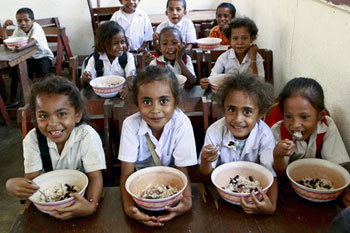
These children in Timor-Leste get a free meal in school. This has
encouraged more students to come to school regularly. It has also meant
that kids in the region go hungry less often. Picture credit: UNITED NATIONS
encouraged more students to come to school regularly. It has also meant
that kids in the region go hungry less often. Picture credit: UNITED NATIONS
- Eradicate extreme poverty and hunger: The goal was to halve the number of poor and starving people in the world. While poverty levels have definitely fallen, the proportion of people living in hunger is decreasing at a much slower pace.
- Achieve universal primary education: In 1999, 106 million children were not going to school. In 2008, that number had dropped to 69 million. Despite this progress, the UN says that it is not happening fast enough to meet the target by 2015.
- Promote gender equality and empower women: The target was to ensure that both men and women would have equal opportunities to study and work. This has been a challenging goal so far. While progress has been made, women continue to have fewer chances than men.
- Reduce child mortality: This means to decrease the number of children who die before the age of five. Thanks to better healthcare and nutrition, 10,000 fewer children under five are dying daily when compared to twenty years back. 95% of countries have shown real improvement, but, this is not enough says the UN. Nine million children still die every year before their fifth birthday, and so it is possible that we won’t be able to reach the target by 2015.
- Improve maternal health: The goal was to reduce by three quarters the number of women who die due to complications in pregnancy and childbirth. Most of these deaths could be avoided if women had access to better healthcare. Even though some countries have made great headway, a large number of women still continue to suffer needlessly.
- Combat HIV/AIDS, malaria and other diseases: The world has succeeded in slowing down the spread of new HIV infections, malaria and tuberculosis. If the current rate of progress continues, there is a possibility that we will reach the desired target.
- Ensure environmental sustainability: We have to make sure that the world we live in is a healthy one. Thus, this goal was added to make sure that all human beings have access to a clean environment and safe drinking water, as well as to ensure that we protect our natural resources. The UN calculates that we will meet or even exceed the target we have set to provide more people with drinking water. However, we are far behind in other areas. A large number of people continue to live in slums with poor facilities, and the number of plants and animals that are threatened with extinction continues to grow.
- Develop a global partnership for development: It is not enough if some countries do well, while others fall behind in development. That is why it is important to unite and work together as a team. Richer countries are not just helping poorer countries by giving them much-needed money and encouraging them to grow their businesses. They are also sharing new technologies and innovations so that everyone can benefit.
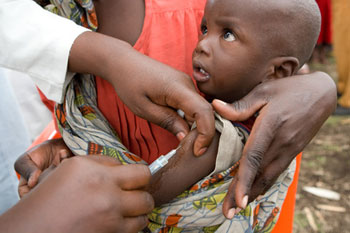
Vaccinations have become more easily available, thanks to which,
children are in better health than before. Picture credit: UNITED NATIONS
children are in better health than before. Picture credit: UNITED NATIONS
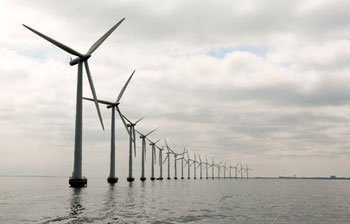
Wind farms use the power of moving air to produce electricity. This is
better than burning coal or oil to produce power as it causes less pollution.
Picture credit: UNITED NATIONS
better than burning coal or oil to produce power as it causes less pollution.
Picture credit: UNITED NATIONS