October, 2011

Wu Chien-Shiung (1912-1997)
Groundbreaking Physicist
Groundbreaking Physicist
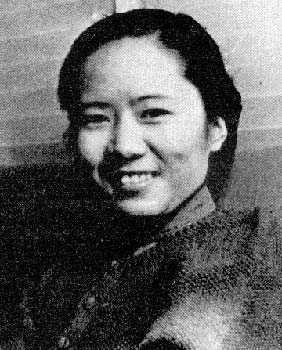
Wu Chien-Shiung grew up in troubled times in China. There had been a revolution just before she was born, and the emperor had been overthrown. Still, there was a lot of corruption and hardship in the land. As a young woman, she led hundreds of students through the streets to protest against President Chiang Kai-Shek.
Her true passion, however, was physics: the science of how matter and energy work with each other. At that time, Chinese universities didn’t teach physics at an advanced level. So, in 1936, she traveled by ship to study in the United States.
Originally, she’d planned to return home after finishing her doctoral studies. But, within a year, China was overcome by the Japanese invasion, so it was impossible for her to go home.
Soon afterwards, World War Two began. She was invited by the US government to work on the Manhattan Project, which would later result in the invention of the atomic bomb. She was the only Chinese scientist to work on this famous project.
By the end of the war Dr Wu was an expert on radioactive decay. This is the process in which atoms break apart to form smaller atoms and other particles. She became well-known for her ingenious, accurate experiments to discover more about this process.
One of her great achievements was disproving “the law of parity”. Scientists had previously assumed atomic particles obeyed this law: after it was disproved, their results became much more understandable. Many believe she should have received a Nobel Prize for this work.
It wasn’t easy for Dr Wu to be a Chinese woman in an American university. Most of these universities didn’t have female students, let alone female professors. She also had trouble speaking English fluently. Her students recall it was very hard to understand her, especially when she got excited.
Still, she was intensely proud of her identity, and almost always wore traditional Chinese clothes under her lab coat. From the ‘80s onwards, she regularly visited China, helping to develop its university programs in physics.
Her true passion, however, was physics: the science of how matter and energy work with each other. At that time, Chinese universities didn’t teach physics at an advanced level. So, in 1936, she traveled by ship to study in the United States.
Originally, she’d planned to return home after finishing her doctoral studies. But, within a year, China was overcome by the Japanese invasion, so it was impossible for her to go home.
Soon afterwards, World War Two began. She was invited by the US government to work on the Manhattan Project, which would later result in the invention of the atomic bomb. She was the only Chinese scientist to work on this famous project.
By the end of the war Dr Wu was an expert on radioactive decay. This is the process in which atoms break apart to form smaller atoms and other particles. She became well-known for her ingenious, accurate experiments to discover more about this process.
One of her great achievements was disproving “the law of parity”. Scientists had previously assumed atomic particles obeyed this law: after it was disproved, their results became much more understandable. Many believe she should have received a Nobel Prize for this work.
It wasn’t easy for Dr Wu to be a Chinese woman in an American university. Most of these universities didn’t have female students, let alone female professors. She also had trouble speaking English fluently. Her students recall it was very hard to understand her, especially when she got excited.
Still, she was intensely proud of her identity, and almost always wore traditional Chinese clothes under her lab coat. From the ‘80s onwards, she regularly visited China, helping to develop its university programs in physics.